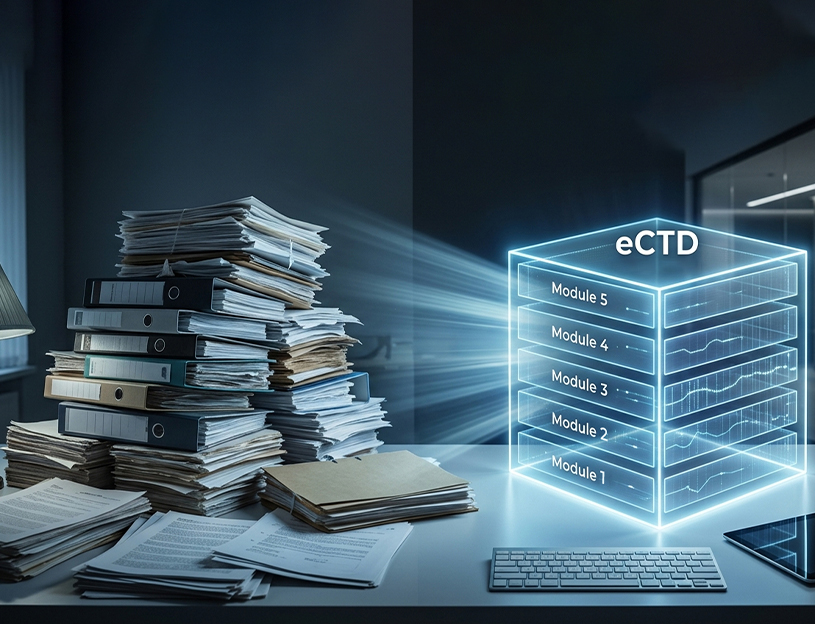
Submitting your first eCTD (electronic Common Technical Document) is a major milestone in the regulatory journey for any pharmaceutical organization. Global health authorities—including the FDA, EMA, and MHRA—now expect structured electronic dossiers that allow them to navigate and review regulatory data efficiently. The eCTD format replaces paper-based submissions with a highly organized, XML‑supported structure that improves traceability and streamlines regulatory review.
If you’re approaching your first eCTD submission, understanding the required structure, technical expectations, and validation workflows is essential to avoid delays, rejections, or compliance findings.
What Is an eCTD Submission?
An eCTD submission is the standardized electronic format used to submit drug applications, amendments, and supporting materials to regulatory authorities. Developed by the ICH, the format ensures consistent organization of data across global regions.
Instead of large paper binders, the eCTD organizes content within a clear folder hierarchy supported by an XML backbone. This backbone connects documents, metadata, and lifecycle instructions so regulators can easily track updates, navigate modules, and manage revisions.
Most major regulatory agencies require eCTD submissions for NDAs, ANDAs, BLAs, and other core regulatory applications.
The Five Modules of an eCTD Dossier
The eCTD is divided into five standardized modules that ensure consistent organization of regulatory information worldwide.
Module 1 – Regional Administrative Information
Contains region-specific forms, labeling, prescribing information, and other administrative documents.
Module 2 – Summaries and Overviews
Includes high-level summaries of quality, nonclinical, and clinical data—such as the QOS and scientific overviews—to help reviewers quickly understand the benefit–risk profile.
Module 3 – Quality (CMC)
Covers Chemistry, Manufacturing, and Controls, including drug substance data, manufacturing processes, batch analysis, stability studies, and control strategies.
Module 4 – Nonclinical Study Reports
Contains toxicology, pharmacology, and animal study reports supporting the safety profile.
Module 5 – Clinical Study Reports
Includes human clinical trial data and reports demonstrating product safety and efficacy.
Common Challenges in First-Time eCTD Submissions
Preparing an eCTD for the first time often reveals unexpected technical and organizational hurdles.
1. Document Formatting Errors
Regulators require strict compliance with PDF standards, bookmarking, hyperlinking, and granularity. Formatting mistakes commonly lead to validation failures.
2. Validation Failures
Errors in metadata, broken links, unsupported file types, or incorrect XML structures can cause regulatory gateways to reject the submission.
3. Lifecycle Management Issues
The eCTD tracks submissions through sequences. Incorrectly replacing, appending, or updating files results in broken lifecycle history and reviewer confusion.
4. Missing or Incomplete Documentation
First-time submitters often overlook required forms, declarations, or region-specific documents, leading to requests for additional information.
How to Prepare for Your First eCTD Submission
Preparing a compliant dossier requires structured planning, attention to detail, and a solid understanding of regulatory expectations.
1. Organize All Required Documents
Begin by collecting all materials for each module. Ensure naming conventions and document structures align with regional guidelines.
2. Build the Dossier According to CTD Module Structure
Place each document into the correct module folder and follow the standard CTD format to maintain consistency.
3. Assign Accurate Metadata and Leaf Elements
Each document must be represented by a leaf element in the XML backbone. Titles, document types, and metadata must be precise for seamless reviewer navigation.
4. Validate the Submission
Use validation tools to verify XML structure, hyperlinks, file formats, and metadata. This step is essential for regulatory acceptance.
5. Confirm Regional Requirements
Module 1 documents vary by region. Double-check that your submission meets all FDA, EMA, MHRA, or other local requirements.
Tools and Expertise That Improve Submission Quality
Managing an eCTD workflow is complex, especially when handling multiple submissions. Specialized publishing tools and experienced professionals can significantly enhance quality and consistency. Modern eCTD solutions automate critical tasks such as:
- metadata entry
- hyperlinking
- PDF optimization
- XML backbone generation
- lifecycle management
- pre‑validation checks
Seasoned regulatory publishing specialists help ensure sequences are accurate, compliant, and aligned with global requirements—a major advantage for first-time submissions.
How Platforms Like eCTD Plus Simplify the Process
Platforms such as eCTD Plus centralize document management, streamline collaboration, automate validation checks, and support publishing roles like Doer, Reviewer, and Publisher.
Features such as automated formatting, hyperlinking, and lifecycle support improve accuracy and reduce submission errors—making tools like eCTD Plus valuable for both beginners and experienced teams.
Conclusion
A successful eCTD submission requires a combination of regulatory knowledge, technical accuracy, and disciplined document management. By understanding the CTD structure, preparing accurate metadata, validating the dossier, and leveraging experienced support or publishing tools, organizations can significantly reduce errors and accelerate regulatory review.
With thoughtful preparation and robust workflows, your first eCTD submission can be both compliant and efficient.
Frequently Asked Questions (FAQs)
The electronic Common Technical Document provides a standardized structure for organizing and submitting regulatory information to health authorities. It improves efficiency in regulatory review and ensures consistent documentation across regions.
Major regulatory authorities such as the FDA, EMA, and MHRA require or strongly recommend eCTD submission formats for many types of drug applications.
The eCTD structure includes Module 1 (administrative information), Module 2 (summaries), Module 3 (quality data), Module 4 (nonclinical reports), and Module 5 (clinical study reports).
Lifecycle management refers to how updates, amendments, or replacements of documents are handled across submission sequences. It allows regulators to track the evolution of a regulatory dossier.
Technical validation ensures that the submission meets regulatory requirements for metadata, XML structure, document formatting, and hyperlinking. Without proper validation, submissions may be rejected by regulatory gateways.